

Pīrāgi is a Comforting Food for Me (Māra Goldsmith)

The pīrāgi recipe that Māra Goldsmith uses every year when baking pīŗāgi for Christmas was passed down to her by Mrs. Arnoldija in Sydney. In this interview, Māra talks about a special trick that makes the dough magical. According to her, it is exactly this that allows you to bake the most delicious pīrāgi in the world!
It’s Not Christmas Without Pīrāgi (Anda Cook)
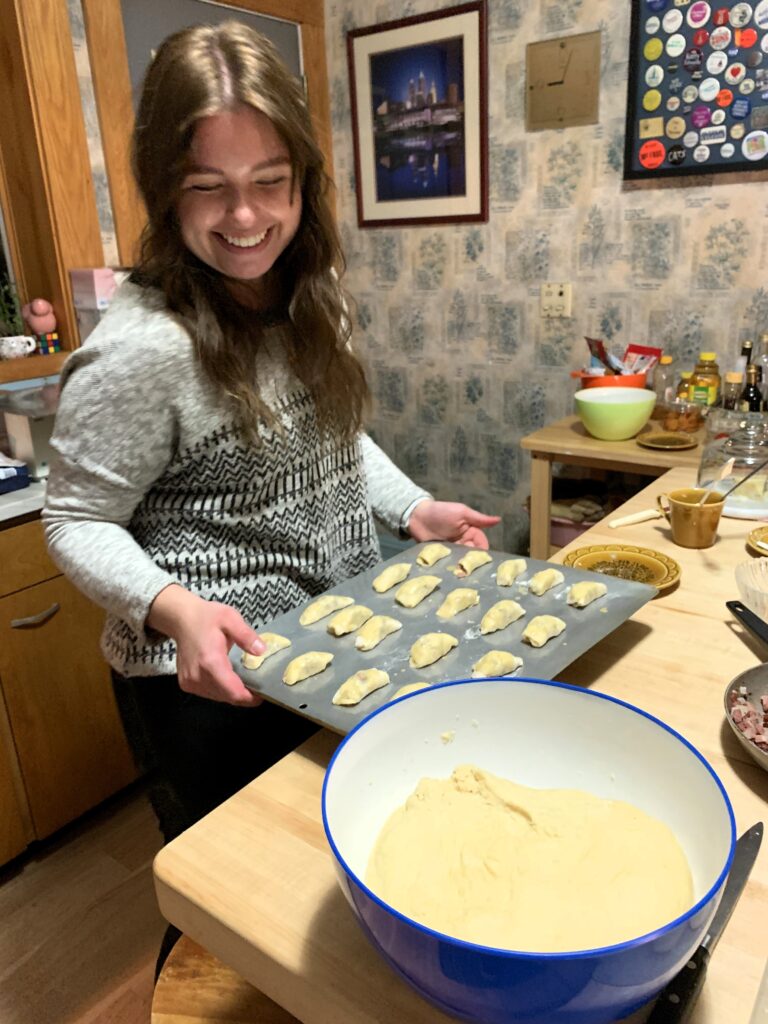
For as long as I can remember, pīrāgi held a place of honor at the Christmas table, and also at Easter. The necessary ingredients were not always easy to find, but my mother made sure to get them in time. In Cleveland, she had discovered a stall at the Westside Market, where she would go after work on Fridays. Her pīrāgi were not only delicious, but she always tried to make them very small, with plenty of meat filling.
My mother has been gone for a long time, and together with my daughter Lisa and granddaughter Greily, we have tried various recipes – but none are quite like my mother’s pīrāgi, neither in appearance nor in taste. The closest we’ve come was a few years ago. We use Dzidra Zeberiņa’s Ģimenes pavards (with a few variations – ed.).
It’s a lot of work, but we listen to Latvian folk songs and linger over memories. Sometimes, it even happens that a pīrāgs gets burned at both ends! And, of course, it’s not Christmas without pīrāgi.
It Smells of Braised Sauerkraut! (Juris Sinka)
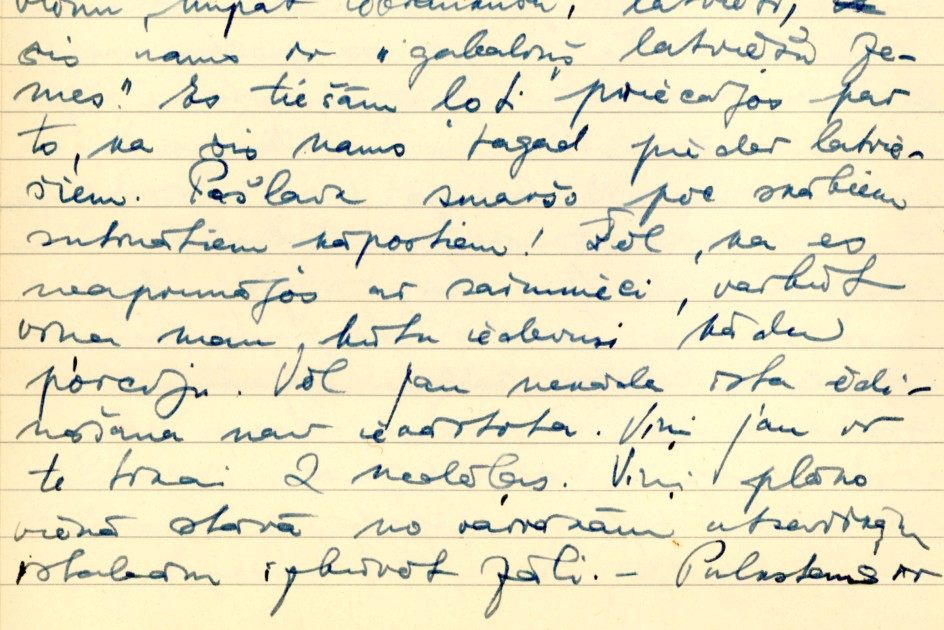
Juris Sinka arrived in the United Kingdom in 1950, where he studied at the University of Oxford. In his diary entry of December 20, 1950, Juris describes how the smell of cabbage filled the recently purchased Daugavas Vanagi house in Queensborough Terrace:
‘I am truly very glad that this house now belongs to Latvians. At the moment it smells of braised sauerkraut! It’s a pity I didn’t talk to the landlady—maybe she would have given me a portion. There isn’t any real catering set up yet. They have only been here for two weeks.’
Communal Baking in Shanghai (Ilma Wilkinson)
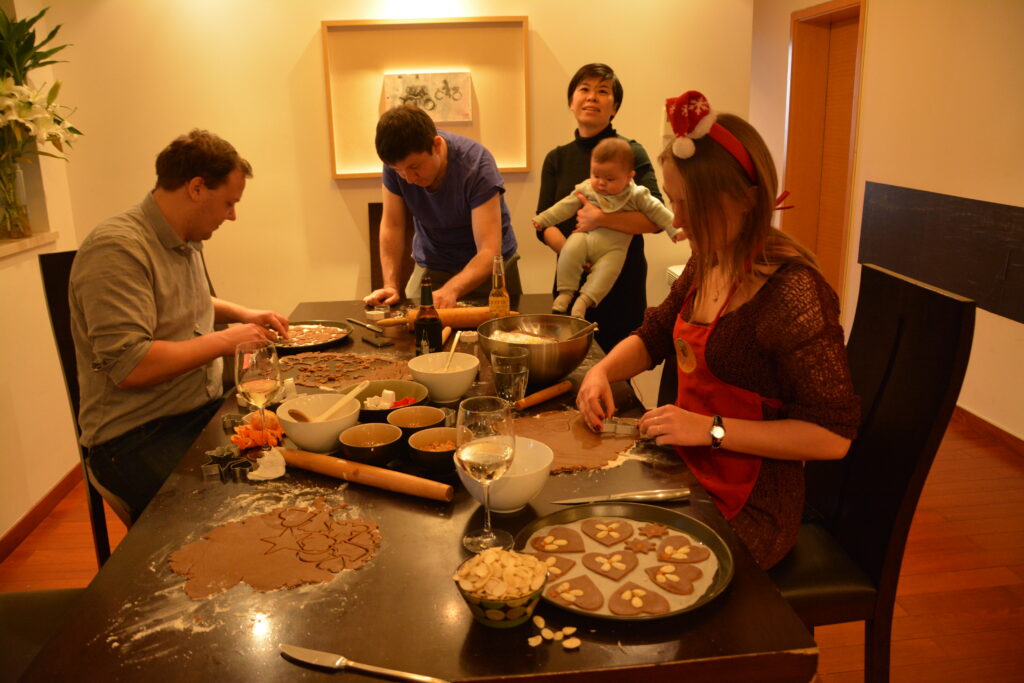
Ilma Wilkinson: “I bake piparkūkas every year — for me, Christmas just isn’t Christmas without “real” Latvian gingerbread. We used to bake together as a family, but when we moved to Shanghai in 2004, we began inviting friends and colleagues to join the tradition — Chinese, Australians, Europeans. In the early years, finding all the necessary spices was more difficult, and some I even had to grind myself.
In 2013, for the first time, the bakers were only Latvians, and the joy of being together was so great that from then on we continued baking gingerbread specifically with the Latvian crowd. We soon added pīrāgi to the tradition as well. Many friends lived in student dorms or apartments without an oven (common in Chinese kitchens), but we were renting a newer apartment and had one available. For those who couldn’t join on the planned baking day, I handed out little portions of piparkūkas dough (which my husband Andrew jokingly called “hashish blocks”) so they could bake at home. By December, our office reception had even gotten used to people dropping by to pick up a lump of dough.
In 2020, we had the largest group ever — because of COVID, many couldn’t travel home for the holidays. That also turned out to be our last Christmas season in Shanghai, as we returned to Australia in October 2021.
To my great joy, I recently received a message from a friend who still lives in China — two years ago, the Latvian Embassy allowed the community to use its kitchen and oven for baking pīrāgi. The new ambassador’s spouse has embraced this as a tradition, and this year, on the first Sunday of Advent, Latvians in Shanghai once again gathered to bake Christmas treats together!”
I Wouldn’t Offer These to Pīrāgi Purists! (Maija Hinkle)
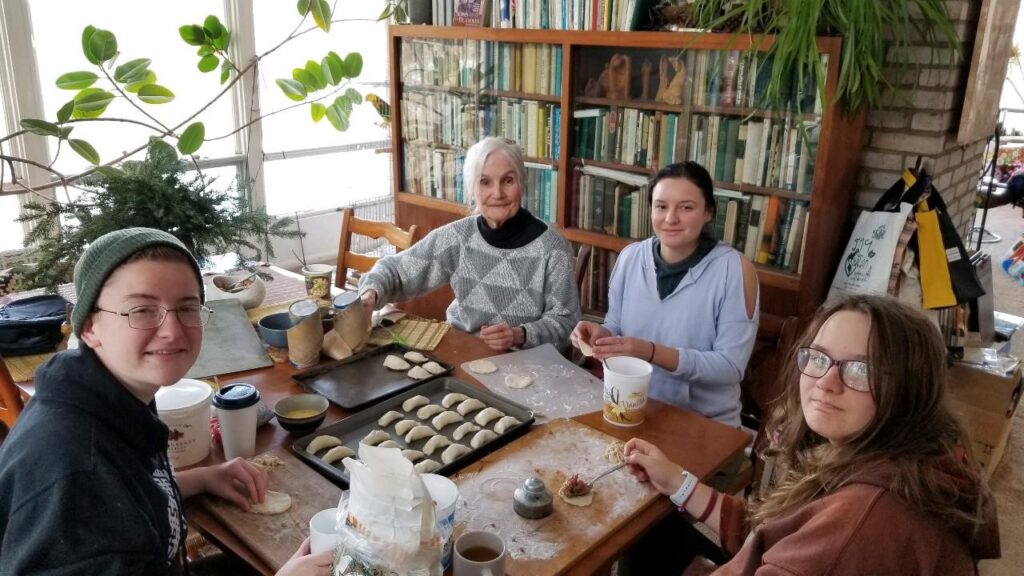
The founder of the Latvians Abroad Museum and Research Center museum shares the story of her family’s pīrāgi baking tradition. The Hinkle family includes several vegetarians, so they have had to invent various filling variations that everyone would enjoy. The family’s creative approach to pīrāgi doesn’t stop at the filling – for convenience, they use store-bought bun dough, and a ravioli press is used to shape the pīrāgi!
Even the Cat Smells Like Cabbage… (Irene Kreilis)

Irene Kreilis: “I prepare braised cabbage according to my own recipe: white pepper, bay leaves, fry the bacon, grind it, fry the onions, caraway seeds. A good amount of brown sugar also helps — half a cup. Six hours in the oven. As it bakes, the edges burn, and that’s the most delicious part. I grate carrots. The cabbage can be reheated for a week. The children complained that even the cat smells like cabbage! The whole house smelled — coats, clothes.”
Story recorded and submitted by Dagnija Roderte.
The House Smells of Smoked Meats and Rasols for Days Afterwards! (Laila Rudzone)

Festive table NOVEMBER 2025 The House Smells of Smoked Meats and Rasols for Days Afterwards! (Laila Rudzone) Germany On the holiday table at home, there’s always rosolīts (potato salad). Every year we agree that this time we’ll make a bit less of it, but somehow it always ends up being a big bowl — and it’s always eaten to the last bite. Sometimes we roast chicken or carp with garlic and dill. And the queen of the table is a homemade cake with lingonberry jam and custard cream. You can make lingonberry-apple jam here in Germany too. I couldn’t find fresh lingonberries anywhere, but you can buy them frozen at the Mix Markt store. Then you put the lingonberries in a pot together with peeled apples, a bit of sugar, and a clove or two for flavor. The jam is ready! You can also buy dill at this store — which turns out to be surprisingly hard to find fresh, crisp, and fragrant in other shops, for salads or boiled potatoes. After the home celebrations, the house still smells of smoke and rosolīts for two more days. Story sent in by Laila Rudzone. NOVEMBER Stories The House Smells of Smoked Meats and Rasols for Days Afterwards! (Laila Rudzone) A Once-a-Year Feast of Latvian Specialities (Maija Liiv) Inta Talks About Celebrations in Her Home A Thin Slice of Lemon and a Sprig of Dill (Ingrīda Hawke) Amber Table (Dace Gulbe and Inta Grunde) Hostesses in Latvian Communities Abroad: in Different Times and Countries. Photographs From the Collection of the Museum Latvians Abroad. Festive Tables of Latvian Communities Abroad: in Different Times and Countries. Photographs From the Collection of the Museum Latvians Abroad. Ladies’ Committee Canapé Party! (Inta Šķiņķis) Ladies’ Committees Helped Maintain the Latvian Community (Aija Abens) The Salmon Looks Like it’s Swimming! (Ingrīda Hawke) No posts found
When Fermenting Cabbage, You Have To Kiss Over the Barrel (Laila Rudzone)
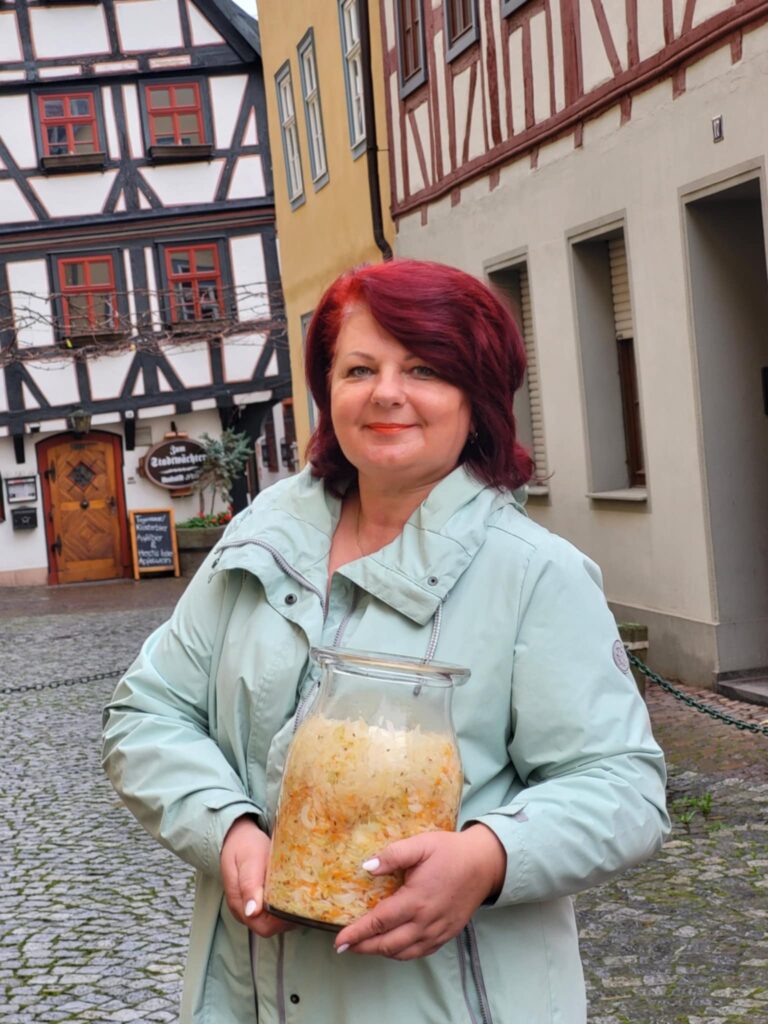
“So it has happened that I’ve been living in Germany for some time now. Homemade food carries a kind of genetic memory — of grandma’s pancakes or dad’s pike patties, those familiar childhood tastes. Even the stewed sauerkraut on the Christmas table reminds me of the cabbage fermenting days at grandma’s countryside home. In autumn, when the big heads of cabbage were harvested from the field, they were piled up in the middle of the yard under a broad oak tree, waiting for busy hands. The yellow oak leaves slowly swirled through the air, falling onto the cabbage heads. The slightly chilly, misty morning was no obstacle to the great cabbage-souring party. A wooden tub was prepared in advance, scalded with boiling water and scrubbed clean. My grandfather made the wooden barrels and tubs himself. From the attic, the cabbage grater was brought down — it had been carefully stored year after year. Grandma, wearing her apron, cleaned each cabbage head thoroughly, peeling away the outer leaves until only the white heart remained. Grandfather placed it on the grater and, pushing the wooden box back and forth, shaved it down. The white cabbage strips, mixed with a few grated carrots and caraway seeds, pleasantly crunched in the barrel under the wooden pestle. The cabbage was pressed until the juice started to separate. When the tub was full, a wooden lid and a stone weight were placed on top, and the cabbage was left to ferment. For about a week, it was poked every day down to the bottom of the barrel so that the gases could escape. From the Lubāna region in Latvia, there’s an old saying that when fermenting cabbage, one should kiss over the tub — then the cabbage will keep well. Everyone who has made sauerkraut can test the truth of that for themselves :))) To make the sauerkraut healthy, rich with good probiotic bacteria that help produce the happiness hormone serotonin in the gut, only salt should be added — 20 grams per 1 kilogram of the combined cabbage and carrot mass. It shouldn’t be oversalted so that it doesn’t need to be rinsed before eating, and all the goodness stays in the cabbage. In the winter season, when someone caught a cold, grandma would hurry to the cellar with a bowl in hand, scoop out some sauerkraut from the big tub, and bring back a dose of vitamin C. For the children, she sprinkled a bit of sugar on top to make it tastier. That vitamin boost would get all the weak ones back on their feet. And there’s strength in sauerkraut juice — many a market woman has revived herself with it after having one drink too many. Cabbage gives strength and health, and that strength goes straight through the stomach. In Germany, I don’t ferment full tubs of cabbage, but smaller amounts — just enough for sauerkraut soup, stewed cabbage with roast pork, or as a salad mixed with chopped onions and oil to eat with pleasure.”
Story submitted by Laila Rudzone. Photograph from Laila’s private collection.
(Originally written in Latvian).
Grandma’s Secret Ingredient Used in Pickled Vegetables (Ana Beatrise Apse-Paese)
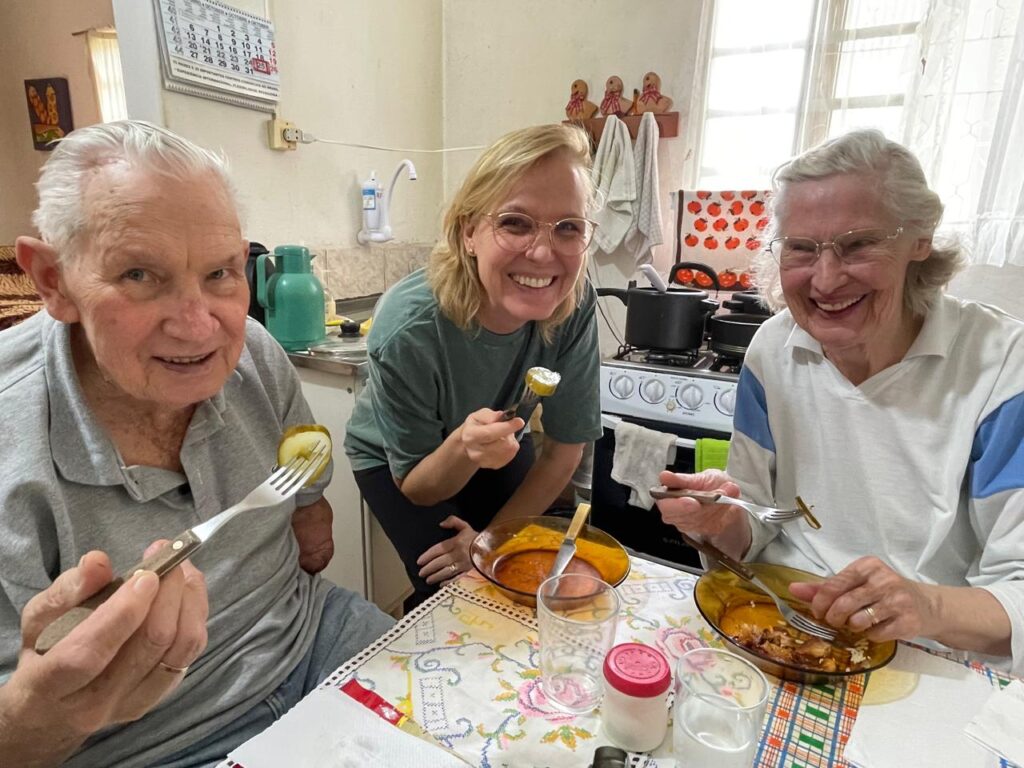
“My grandma, Eunise, pickles vegetables on the regular. Cucumber, carrots and cauliflower. She adds onion and garlic and her secret ingredient are cloves. She cooks them in water, vinegar and salt (two cups of vinegar for four large cucumbers) until the cucumber loses its green hues and then stores it in jars in the fridge. My grandparents eat pickled vegetables everyday at lunchtime. As kids, me and my siblings were never fond of pickled vegetables, but my mom, Leila, has always had quite Latvian tastebuds, so, when we went out to eat burgers, we would all pick out the pickles to give to her, who gladly ate them. As a grown-up, I now appreciate my grandma’s pickles and reproduce them in my small apartment in Germany, where I study.””
Story submitted by Ana Beatrise Apse-Paese. Photos are from Ana’s personal archive.
A Once-a-Year Feast of Latvian Specialities (Maija Liiv)
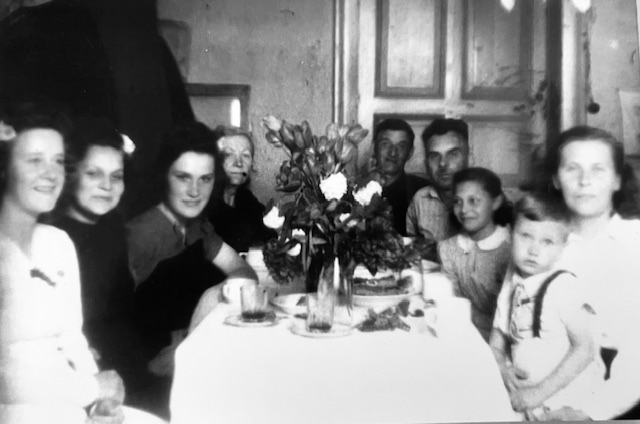
My family left Latvia in 1944, and settled in Brisbane, Queensland, Australia, in 1950 and I was born here. At this pre-Christmas time of year I think back, with nostalgia, to the once-a-year feast of Latvian specialties of my childhood.
My brother and I had birthdays either side of Christmas Day, so there was always a huge family and friends party at our house then.
The anticipation and preparations started long before. I remember taking out our best plates and serving dishes, cleaning the rarely-used silverware, and shopping at the far-away delicatessen that was the only place in those days that had the ingredients we needed for our party table. I loved the sights and smells of that delicatessen, as well as the sounds of many languages spoken by customers.
My mother (Lauma Sīlis) baked her own rye bread and sweet-sour bread, bacon rolls, cinnamon buns and poppy seed buns, pepper cakes, and our birthday tortes. She assembled platters of what seemed ‘exotic’ cold-cuts in those times of comparatively very plain Australian food. There was smoked salmon, rollmop herrings, sprats, smoked eel, tongue, and salami. The making of meat-in-aspic involved a trip the to butcher’s shop to buy a pig’s head. In those days,1950’s 60’s, pigs’ heads (wearing sunglasses, very tropical) were displayed in butcher shop windows.
She also made her own pate, rasols (with beetroot), stuffed eggs, fresh cucumbers in sour cream, and home-pickled cucumbers, and countless other traditional Latvian treats.
Australian Christmas staples were also on the table: ham, home-roasted chicken (after killing and plucking), prawns, trifle, and Christmas fruitcake.
My mother Lauma did all this as a single mother (separated), who also worked in full-time employment as a shop assistant. I honour her for her effort, her planning and coordination, her ability to save all year for this annual expense, and most of all for her love and for her incredible culinary talent. This woman, who left Latvia as a 17 year old, gave us our Latvian heritage and the most amazing childhood birthday/Christmas memories. Unforgettable.