
Dzidra Ādamsone writes in an email in 2003 about her pīrāgi recipe.
“…For many years I didn’t have one (a pīrāgi recipe), and I used to laugh that the knowledge of my ancestors must simply be in my blood… Everyone kept asking, and I said I didn’t have it and felt awkward, because people thought I just didn’t want to share it. Then my wise husband advised me that the next time I made them, I should weigh everything once. That’s what I did, and now I can give my recipe to everyone. Among foreigners so far only one of my neighbors—a Portuguese woman—has managed to get them right. I think people don’t let the dough rise enough, and then the pīrāgi aren’t soft, or they make the dough too heavy by adding too much flour.
First, the ingredients: 1 liter of milk, flour as needed, 400 grams of margarine, 400 grams of sugar, fresh yeast, salt to taste, about 4 or 5 eggs, and 1 nutmeg, grated. I put the milk with salt into an aluminum bowl, place it on the stove, and warm it until lukewarm. Then I stir flour into the milk so it becomes a fairly runny porridge. I put our fine sugar on the yeast beforehand so it becomes liquid. I mix the yeast (about 100 g?) into the porridge, cover it, and place it in a warm spot for the first rise.
When the dough starts to bubble, the real kneading begins. Meanwhile, in an electric mixer, everything—the butter, sugar, eggs, and grated nutmeg—has been beaten together as if for a cake. My mother used to say that eggs technically aren’t necessary at all, but when you cream butter with sugar, the mixture is very dry and thick, so I add the eggs to make it easier to combine.
Since you’ll have a helper, Anniņa, you can confidently put your hands into the dough and knead it thoroughly, even “give it a good beating.” The dough has to be very well worked—you mustn’t spare your energy. The softer the dough, the tastier and softer it will be when baked. Of course, there is a point when the dough starts to come off your hands; otherwise, you won’t be able to get the filling into the pīrāgi. I use flour when making pīrāgi, and even so, in some of them the filling wants to “escape.”
I make the pīrāgi so that they’re about two bites each, because if they’re too small, they seem to dry out. Once the pīrāgi are on the baking tray, they must be allowed to rise, and only then should they be brushed with beaten egg and put into the oven. You can use the same dough for savory breads and caraway rolls as well.
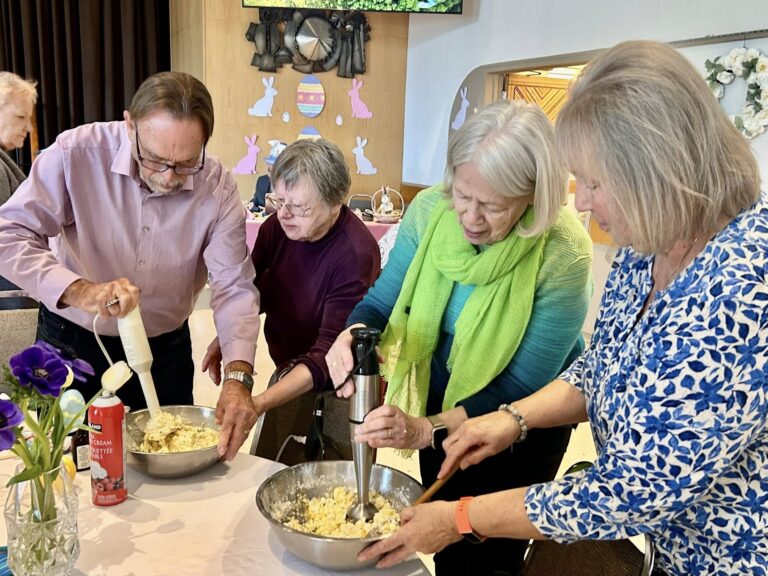
Buy good, tasty, well-streaked bacon, and cut it by hand (electric grinders are no good!), and chop just as many onions, about 20 percent of the filling—that is, I use quite a lot of onions. I don’t fry the meat and onions, as some Latvian women do, but I taste the mixture, because you definitely need to add black pepper—what they call Turkish pepper—and, if necessary, salt. Since my dough is slightly sweet, the filling needs to provide a contrasting note.
I very, very much hope that you’ll enjoy my pīrāgi, which are my mother’s family recipe and have been passed down to me! If the dough seems a bit too sweet for your taste, next time you can use less sugar. You know, I don’t cook—I don’t like it and it doesn’t come naturally to me—except for a few Latvian dishes… Bon appétit!”