

“Ķīselis” in interview excerpts from Latvians in Bashkortostan

”Ķīselis” in interview excerpts from Latvians in Bashkortostan. Interviews took place during a museum expedition in 2009.
Let’s do it the way we do it in this century, in this era (Inese Grava-Gubiņa)

Fragments from an interview with Inese Grava-Gubiņa, July 13, 2025.
White bread is like cake – doesn’t fill you up! (Smuidrīte Jinkinson)

Excerpt from an interview with Smudirīte Jinkinson in the United Kingdom in 2016, when the museum visited her during a field expedition:
And then, when we arrived in Corby, somehow – I don’t know how – they [my parents] found out that rye flour could be ordered from Scotland. So they ordered flour from Scotland, and then my mother baked bread almost every week. Because really, as she used to say, white bread is like cake – it doesn’t fill you up. You eat a slice of rye bread and right away you feel that you’ve actually eaten. The flour came by post! … I remember when I was in grammar school – [my friends] were Penny and Marina … and I don’t know how we had decided that we wouldn’t stay at school for lunch. I know my mother had baked bread, and we went to my house, because it wasn’t very far from the school. And we had a really good lunch at my place with this rye bread. They liked it so terribly much!
Where do you find bolted flour in Philadelphia? (Inta Grunde and Valdis Bašēns)
Excerpt from an interview with Inta Grunde and Valdis Bašēns in Philadelphia, USA, in 2015, when the museum met them during a field expedition:
Inta: My mother always looked for what she called bolted flour. Not the dark rye flour, but bolted flour. It’s very hard to find here. I have to drive half an hour north to a kind of warehouse, where I have to place a special order. Then I buy 100 pounds at a time. Because the dark rye flour we can buy in small bags here and there, but the bolted flour we can’t.
Valdis: About that flour – we lived, when we first arrived, in a place where there were many Estonians and many Japanese, and also Latvians. And in the local grocery store you could get exactly that kind of flour. For years all the Estonian and Latvian women went there to buy it. And when the owner retired and closed the shop – now it’s desperation. Where do you get it?
Thai style “frikadeļu” soup (Inese Grava-Gubiņa)
Fragment from Inese Grava-Gubiņa’s interview with Latvieši pasaulē curator Marianna Auliciema, November 28, 2025.
Around 2006, 2007, and 2008—that was the time when we began teaching the first Latvian cooking classes at the Gaŗezers Summer High School. After that, a year passed, and I returned again—this time for the second time—to teach.
We worked with teenagers—young people aged 14–17. In the first year, I think Latvian cuisine as a class hadn’t been offered for some time, or only very minimally, and I don’t really know how it went back then. But in the year when I started, the group consisted only of girls. I remember how we laughed and joked, saying that those silly boys preferred to go play volleyball on the beach in the heat. They could have come into a cool room, cooked food together, and eaten. And besides—all those beautiful girls they could have gotten to know better!
In the second year, I had boys! Somehow they figured out that it wasn’t so bad to be in the kitchen and work together making food. It was very interesting… there were no problems in either year, but the dynamic completely changed once the boys showed up.
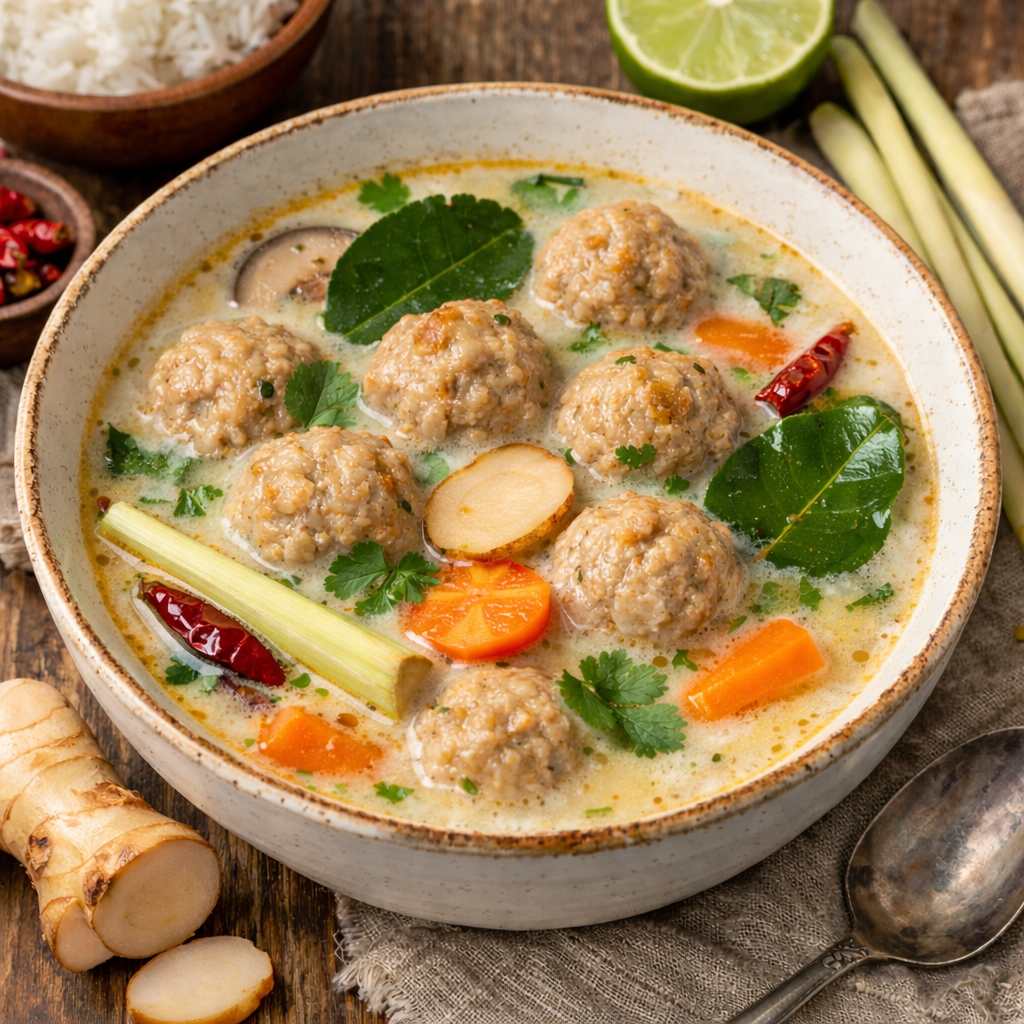
We already made soup in the first year—”frikadeļu” soup, though not exactly the usual kind. I wanted something more interesting, so I had brought along some special Thai-style spices from home. Around Gaŗezers there aren’t many exotic shops where you can get everything. I had brought (I don’t know what it’s called in Latvian) lemongrass—citronzāle—and something called galangal (I don’t know the Latvian name either)—a root that looks like ginger but has a different taste and aroma. And kaffir lime leaves—those things I brought with me from Canada. And then coconut milk.
So we made the “frikadeļu” soup the way it’s usually made—add whatever you want! I think I even made it with chicken or turkey, which I found at a big grocery store, because I had to make a very large amount—such a quantity! We made the meatballs and cooked the soup. Then we added the galangal, lemongrass, and kaffir lime leaves. And I also added—because I had them—dried hot peppers. I grow them in my garden and then simply dry them. In winter, if I need a little bit of heat, I throw one dried pepper into the pot, let it cook there, and then pull it out. It gives just a little kick, not so much that your tongue is on fire.
That’s how we made the soup, and then—right before it was ready—we poured in a few cans of coconut milk. And there you have it: Thai-style “frikadeļu” soup!
I already knew it would be a hit, because these young people… Well, there were some things they really liked, but other things they ate rather reluctantly. This soup—they went back for a first, second, third bowl, and I think some of them would have eaten even more if they hadn’t had to go to their next classes. They absolutely loved it! It’s “frikadeļu” soup, but with a different flavor.
The decorating process takes seven hours (Anita Kupcis-Clifford)

Anita writes: “After seeing some videos of cookies being decorated I was intrigued. That was seven years ago and since then I have decorated many cookies. My sense of design for my cookies might be attributed to my years of embroidery, specifically Latvian designs.
My piparkukas are different from my mom’s, hers were rolled very thinly and glazed with egg yolk. I recall when my mother would come for visits with a suitcase full of piparkukas, pirags and pounds of butter. I started making both when my mother was no longer able to do it.”
My family pīrāgi recipe – with commentary (Aivars Sinka)

Aivars Sinka: “Quite often my English acquaintances wanted to try baking pīrāgi, so I wrote the recipe in English. I used to bake a lot. It felt important to me that my daughters understood that Latvian food is different from English food. I often put a pīrāgs in their school lunchbox.
I bake my pīrāgi using the same recipe my mother used and, very likely, the one her mother used as well.”
The house smells of smoked meats and rasols for days afterwards! (Laila Rudzone)

Festive table NOVEMBER 2025 The house smells of smoked meats and rasols for days afterwards! (Laila Rudzone) Germany On the holiday table at home, there’s always rosolīts (potato salad). Every year we agree that this time we’ll make a bit less of it, but somehow it always ends up being a big bowl — and it’s always eaten to the last bite. Sometimes we roast chicken or carp with garlic and dill. And the queen of the table is a homemade cake with lingonberry jam and custard cream. You can make lingonberry-apple jam here in Germany too. I couldn’t find fresh lingonberries anywhere, but you can buy them frozen at the Mix Markt store. Then you put the lingonberries in a pot together with peeled apples, a bit of sugar, and a clove or two for flavor. The jam is ready! You can also buy dill at this store — which turns out to be surprisingly hard to find fresh, crisp, and fragrant in other shops, for salads or boiled potatoes. After the home celebrations, the house still smells of smoke and rosolīts for two more days. Story sent in by Laila Rudzone. NOVEMBER news The house smells of smoked meats and rasols for days afterwards! (Laila Rudzone) When fermenting cabbage, you have to kiss over the barrel (Laila Rudzone) Grandma’s secret ingredient used in pickled vegetables (Ana Beatrise Apse-Paese) What I truly miss here when I think of Latvia A once-a-year feast of Latvian specialities (Maija Liiv) Inta talks about celebrations in her home / Philadelphia, USA Amber Table (Dace Gulbe and Inta Grunde) Hostesses in Latvian communities abroad: in different times and countries. Photographs from the collection of the museum Latvians Abroad. Festive tables of Latvian communities abroad: in different times and countries. Photographs from the collection of the museum Latvians Abroad. Ladies’ Committee canapé party! (Inta Šķiņķis) Ladies’ Committees helped maintain the Latvian community (Aija Abens) Mom runs around the stores looking for the “right” kind of cabbage The salmon looks like it’s swimming! (Ingrida Hawke) Searching for Latvian mushrooms How can you shred cabbage without having a beer? (Pēteris Freimanis) Little Māra went into the forest… Ēriks and Aina on mushroom picking Fermenting for three generations in Canada (Aija Zichmane) Liene pickles cucumbers Madara Riley – Mushroom Maddie Certified mushroomer from Michigan (Larisa Mednis) Are you going to send me to mushroom school? (Austra Muižniece) Liene makes kotletes (rissoles) Sauerkraut-making workshop in Melbourne No posts found
Inta talks about celebrations in her home / Philadelphia, USA
…In our home, 2–3 days beforehand we were already preparing all kinds of dishes. Sometimes, at our house, we ate three times: everyone gathered for dinner around six o’clock and ate the hot meal; then afterwards, the men went off to play cards, the women washed the dishes, and then there was the coffee table; and around two or three in the morning, my mother set out the smorgasbord.
From an interview with Inta Grunde for the museum “Latvians Abroad.” Interviewed by Ieva Vītola in 2016.
Mom runs around the stores looking for the “right” kind of cabbage
Inese Šteinbaha: We make our own sauerkraut. My mom, Māra Rozenberga, is the one running around the stores looking for the right kind of cabbage. She knows exactly what they should be like. We even have our own cabbage slicer, brought from Latvia.