

“Ķīselis” in interview excerpts from Latvians in Bashkortostan

”Ķīselis” in interview excerpts from Latvians in Bashkortostan. Interviews took place during a museum expedition in 2009.
In 20 minutes and without a recipe – “The Truly Latvian Easter Paska Competition”
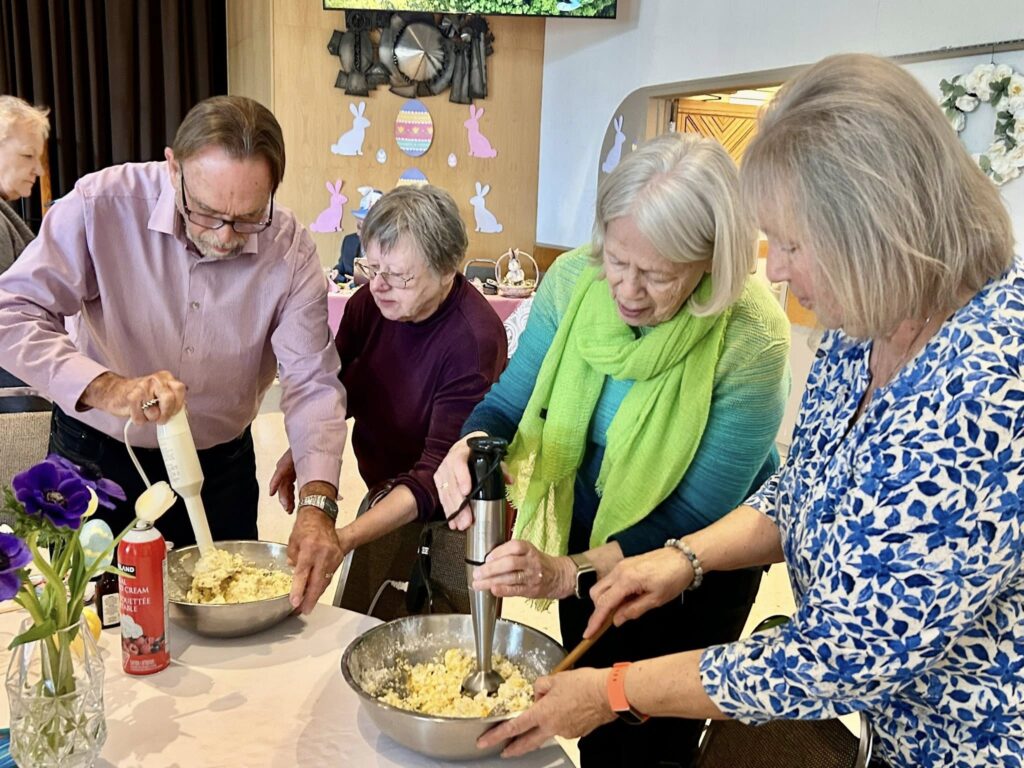
The ‘Truly Latvian Easter Paska Competition,’ led by Māra Gulēna and Elizabete Ludvika, was held at the Toronto Latvian Seniors Association (TLPA) gathering on April 17, 2025.
Latvian sweet soup in Brazil
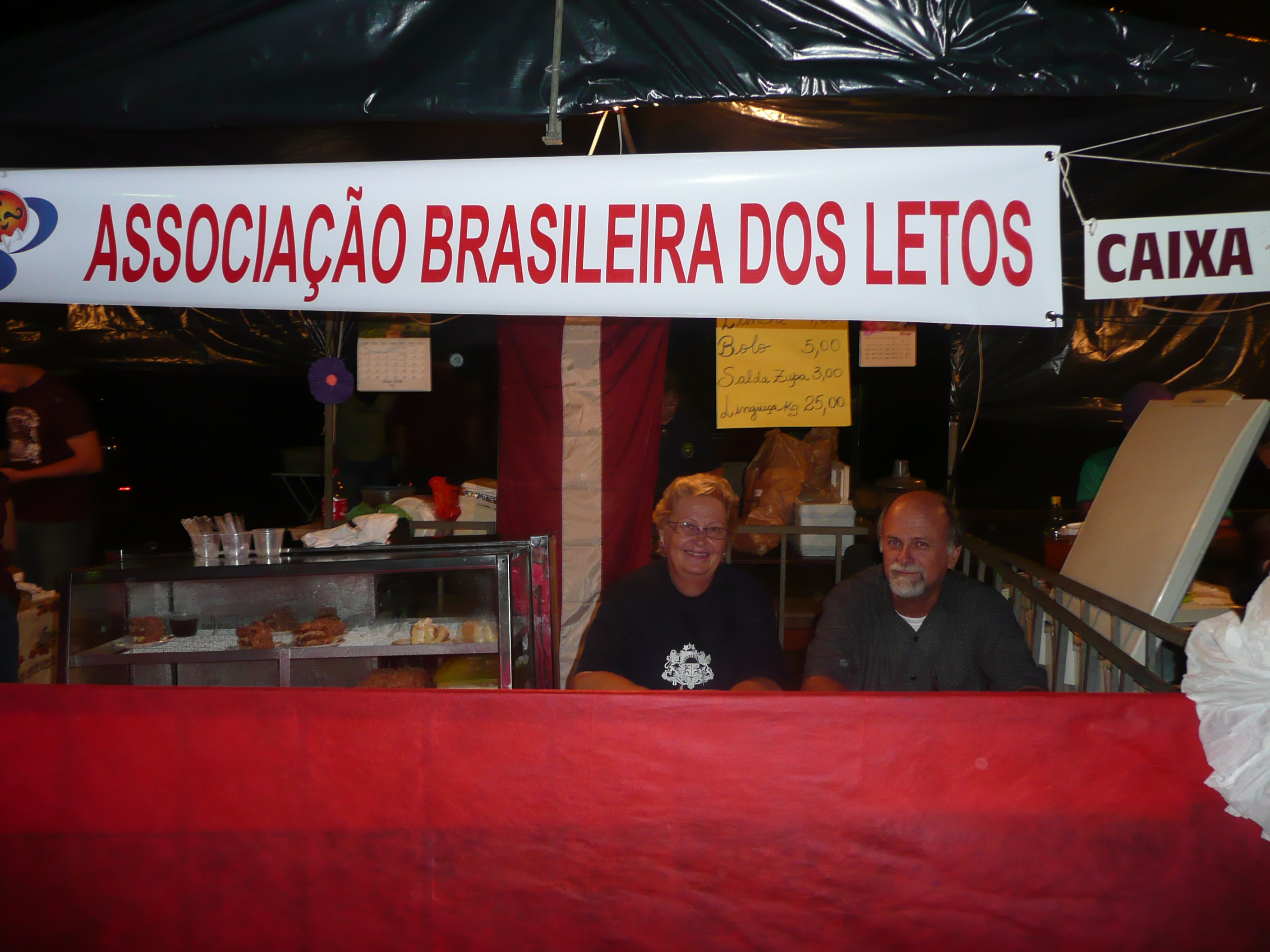
In 2009, the museum went on an expedition to Brazil. During the expedition, a multicultural food market in the city of Americana was also visited, where local Brazilian Latvians had their own stand offering traditional Latvian dishes. One of the dishes available for purchase was “sweet soup.” The photo shows Erliņš Arājs with his sister Nansi.
Let’s do it the way we do it in this century, in this era (Inese Grava-Gubiņa)
Fragments from an interview with Inese Grava-Gubiņa, July 13, 2025.
Give us today our daily bread (Rūdolfs and Irma Grava)
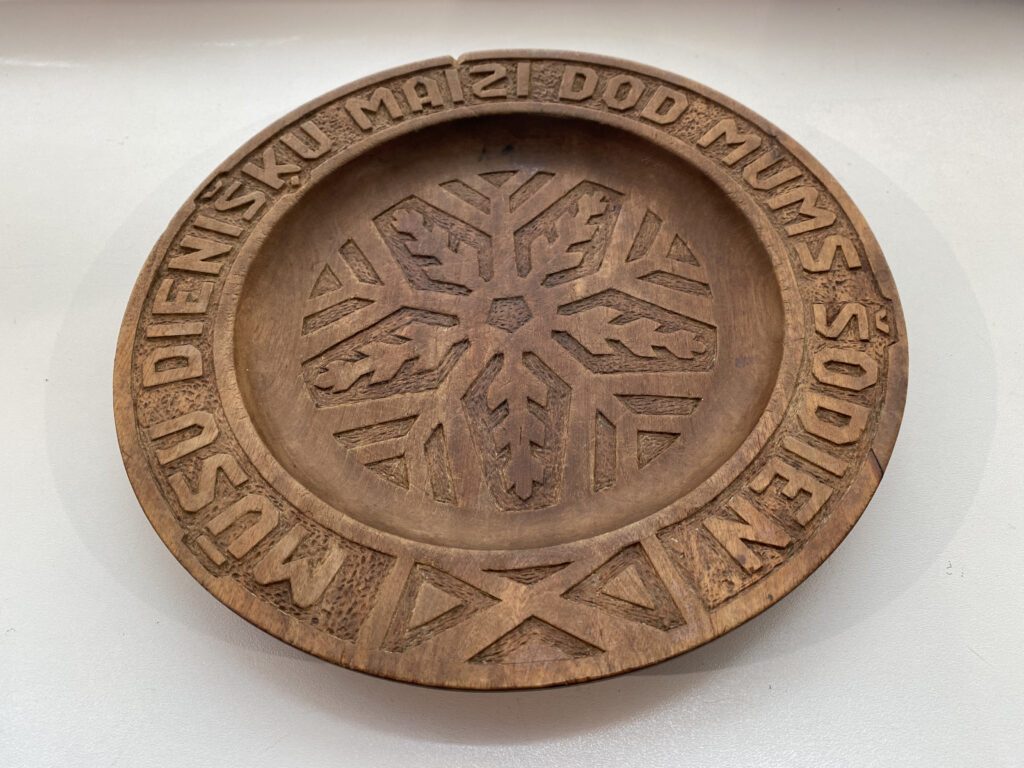
The Liepāja handicrafts teacher Rudolfs Fridrihs Grava made this bread platter in 1929 as a wedding anniversary gift for his wife, Irma Grava (née Mindenbergs). Irma and Rudolfs took this platter with them when they fled with their four youngest children during the Second World War, leaving Liepāja aboard an evacuation ship. Later, they packed the platter among their belongings when moving from a refugee camp in Germany to their new country of residence, the United States. After arriving in Baltimore, USA, the bread platter proved useful—it is believed that for many years it served in the Grava family’s large household both as a bread platter and as a cherished reminder of their wedding in their homeland. The plate was donated to the “Latvians Abroad” museum by Rūdolfs and Irma’s children, Artūrs Grava and Edīte Zariņa.
Whenever my mother baked bread, the entire house smelled wonderful (Mārīte Krūze)
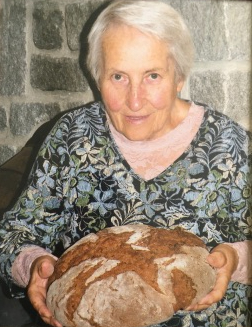
Mārite Krūze (USA) tells the story of her mother, Valentīne Upats (née Macāns, born in Rēzekne in 1924), and her bread baking.
My mother, Valentīne Upats, recalled how she began baking rye bread during her retirement years. Her bread became very popular in our New Jersey congregation. She baked with great joy and generously shared her bread with others.
The well-known Visvaldis Dzenis even wanted to purchase a special mixing machine to make kneading easier and to be able to produce a larger quantity of bread, but my mother refused. It was important to her to knead the dough herself—to do it properly and to feel the dough with her own fingers. She also had a bit of arthritis in her fingers, and this activity served as good exercise for them.
My mother believed she had received the recipe from a relative in Latvia, and later adapted it to suit herself and the ingredients available in the United States.
Whenever my mother baked bread, the entire house smelled wonderful for two days! I remember that once the loaves were finally baked, my mother and father would sit down at the table and immediately enjoy the fresh, warm bread. My father always received the first loaf. His task was to slice the bread evenly so that delicious buttered sandwiches could be prepared for the church luncheon table. For this purpose, he had purchased a special slicing device.
It was always important to my mother to find high-quality rye flour. She became acquainted with a baker who milled his own rye. My mother spent an entire day with him, discussing the sourdough starter, the dough composition, and other details. Her bread was baked in a wood-fired oven—and this was the loaf she was most proud of. The baker honored her by selling “Valija’s Latvian Rye Bread” at the market that summer.
We tried baking rye bread together, but it seems I never quite acquired the skill… Perhaps one day I will try again to bake this delicious bread, though I already know it will never receive the same admiration as my mother’s bread.
White bread is like cake – doesn’t fill you up! (Smuidrīte Jinkinson)

Excerpt from an interview with Smudirīte Jinkinson in the United Kingdom in 2016, when the museum visited her during a field expedition:
And then, when we arrived in Corby, somehow – I don’t know how – they [my parents] found out that rye flour could be ordered from Scotland. So they ordered flour from Scotland, and then my mother baked bread almost every week. Because really, as she used to say, white bread is like cake – it doesn’t fill you up. You eat a slice of rye bread and right away you feel that you’ve actually eaten. The flour came by post! … I remember when I was in grammar school – [my friends] were Penny and Marina … and I don’t know how we had decided that we wouldn’t stay at school for lunch. I know my mother had baked bread, and we went to my house, because it wasn’t very far from the school. And we had a really good lunch at my place with this rye bread. They liked it so terribly much!
“Lett’s Bake” sourdough
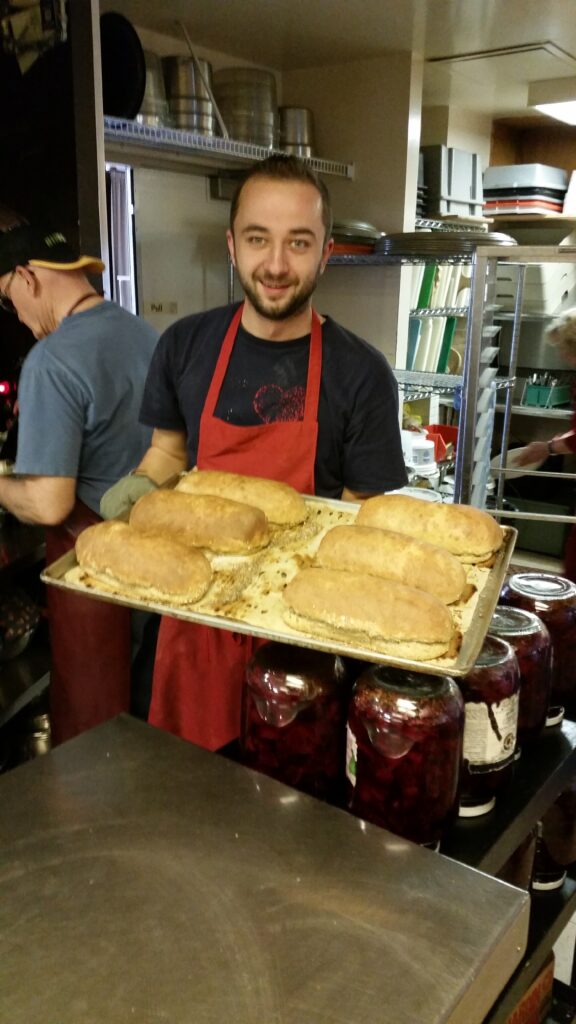
The Latvians Abroad museum met Mareks Nēgels in 2015 at the Toronto Latvian centre – he was baking “Lett’s Bake” sourdough.
A bread oven built from an anthill (Edith Siemel)
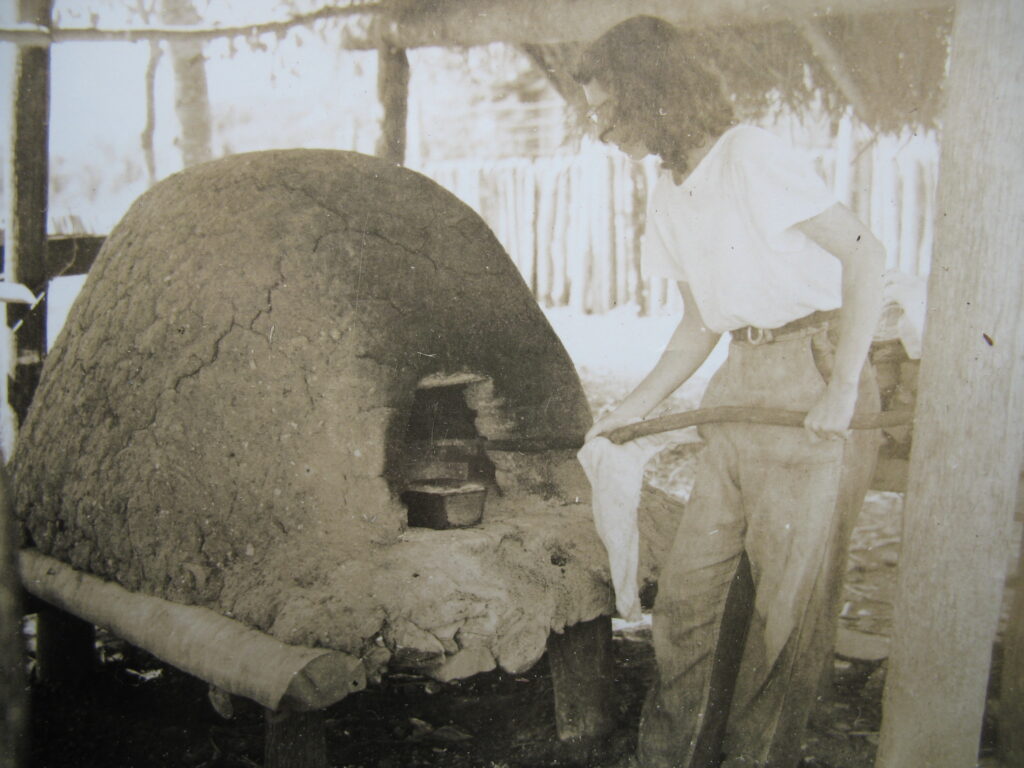
Aleksandrs Ziemeļs’s wife, Edīte (Edith Louise Bray Siemel), stands by a bread oven built from an anthill.
Where do you find bolted flour in Philadelphia? (Inta Grunde and Valdis Bašēns)
Excerpt from an interview with Inta Grunde and Valdis Bašēns in Philadelphia, USA, in 2015, when the museum met them during a field expedition:
Inta: My mother always looked for what she called bolted flour. Not the dark rye flour, but bolted flour. It’s very hard to find here. I have to drive half an hour north to a kind of warehouse, where I have to place a special order. Then I buy 100 pounds at a time. Because the dark rye flour we can buy in small bags here and there, but the bolted flour we can’t.
Valdis: About that flour – we lived, when we first arrived, in a place where there were many Estonians and many Japanese, and also Latvians. And in the local grocery store you could get exactly that kind of flour. For years all the Estonian and Latvian women went there to buy it. And when the owner retired and closed the shop – now it’s desperation. Where do you get it?